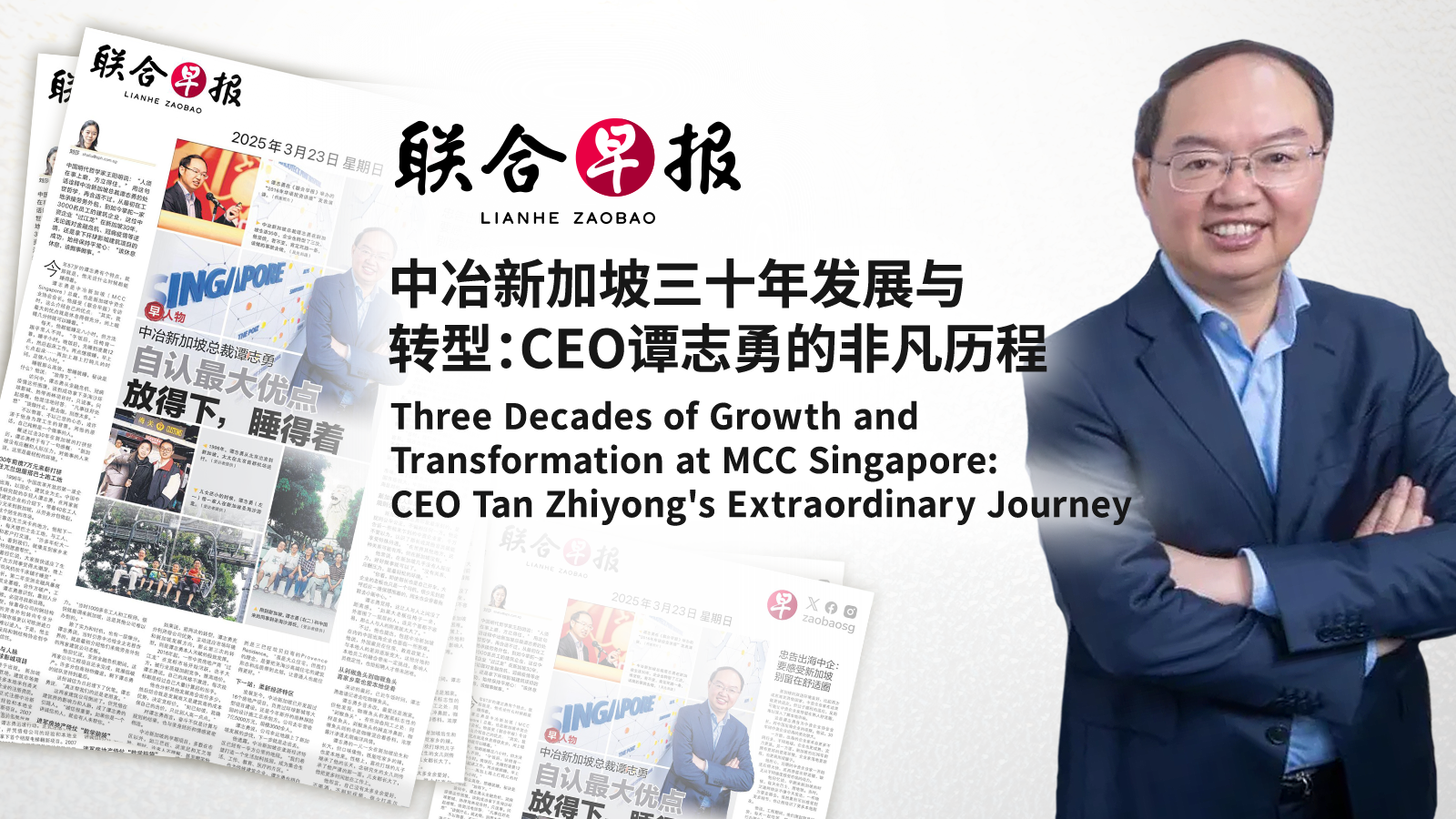
Thirty years ago, Tan Zhiyong ventured to Southeast Asia with little more than a team of workers and $70,000. Today, as the CEO of MCC Singapore, he reflects on his extraordinary journey with a unique perspective on life and work. "Let go of worries, and sleep at ease!" he shares, adding that his ability to rest well has been one of his greatest strengths. At 57, Tan is able to fall asleep anytime and anywhere, a skill he believes is essential for staying focused and efficient in his demanding role. As both the CEO of MCC Singapore and Chairman of the Singapore China Enterprises Association, Tan recently shared this distinctive trait during an interview with Lianhe Zaobao, noting that a good night's sleep is key to maintaining his energy levels and decision-making clarity.

Mr. Tan Zhiyong, CEO of MCC Singapore and Chairman of the Singapore China Enterprises Association, has led the company through three transformations over his 30 years in Singapore. "If you don't adapt, failure is certain. Change offers survival, though success isn't guaranteed. Don't be afraid—do what must be done," he advises. (Photo by Wu Xianbang)
A Balanced Approach to Rest and Work
Tan's approach to sleep is unique yet highly effective. He ensures he gets eight hours of rest each day, but his routine differs from most. After lunch, he takes a half-hour nap, comfortably leaning in his chair. In the evening, he sleeps from after dinner until midnight, then wakes briefly to catch up on work. By 2 a.m., he returns to sleep until 7 a.m., totaling his rest for the day. "Letting go" is the key to his ability to rest so efficiently, allowing him to stay relaxed and energized for the demands of leadership. His personal philosophy is simple but effective—remain calm, stay positive, and focus on the task at hand.

Mr. Tan Zhiyong maintains a detailed monthly-updated database of all Singapore property transactions since 2000 to build an accurate picture of reality. (Photo by Wu Xianbang)
Overcome Challenges and Seizing Opportunities
Reflecting on his 30 years in Singapore, Tan highlighted the significant challenges he has faced, from navigating the Asian financial crisis to weathering the impacts of the COVID-19 pandemic. Yet, he has also celebrated significant achievements, such as securing major projects like Universal Studios Singapore and the Mandai Rainforest development. Tan's approach to overcoming these challenges is grounded in a pragmatic and optimistic mindset. "Think positively about everything," and "Do what needs to be done; don't overthink it," he advises. This mindset, coupled with his engineering background, has made him a "get-things-done" leader who focuses on delivering results.
Tan's journey in Singapore began humbly. When he first arrived with just $70,000 and a small team of workers, he rented a simple HDB flat in Woodlands, commuting daily by bus to construction sites. He recalls the early struggles with warmth and humor, noting that many of his northern Chinese colleagues struggled with the local humidity. "They had to use a hairdryer to dry their beds before sleeping," Tan laughs, highlighting the small hurdles they overcame in their early days in the city.

In 1996, Mr. Tan Zhiyong departed from Beijing for Singapore, seen off by his wife at Beijing Capital International Airport.
Adapting and Evolving for Success
The Asian financial crisis in 1997 dealt a blow to the construction industry, but it also sparked a pivotal shift for Tan. Realizing that relying solely on subcontracted projects was unsustainable, he transformed his business model by leveraging steel structure technology from the parent company. Over time, Tan established a reputation for quality and reliability, gradually winning the trust of the Singaporean market. His perseverance paid off in 2004 when the Singapore government's push for integrated resort destinations created significant opportunities for foreign construction firms. Seizing this moment, Tan formally established MCC Singapore, quickly securing its first contract—a Housing Development Board (HDB) lift refurbishment. Soon after, the company went on to secure landmark projects, including Resorts World Sentosa and Universal Studios Singapore. Tan attributes much of this success to his timely actions and the strong network of industry contacts that he and his team had cultivated over the years. "At that time, we had more than 1,000 workers and engineers ready to mobilize immediately—an advantage few other companies possessed," he recalls. Yet beyond strategic strength and timing, Tan attributed part of this success to long-standing relationships. Interestingly, it was the very same construction company owners who initially introduced MCC to labor outsourcing who recommended MCC Singapore to the developers of Resorts World Sentosa. Tan vividly recalls that during the financial crisis, these two contractors faced imminent bankruptcy, with many subcontractors pulling out. Despite the uncertainties, Tan’s team persevered to see the projects through to completion. "If we had abandoned them early on, convinced they were doomed to fail, their collapse would have been faster," Tan reflected thoughtfully.
This unwavering commitment and integrity established deep trust, laying a strong foundation for future opportunities. "It was truly our old friends who helped us," Tan said appreciatively. Even though these two construction companies eventually closed down, their industry influence and established networks proved invaluable, guiding Tan through crucial connections. "Integrity is very important," he emphasized. "If you remain honest and trustworthy, people will naturally step forward to help you."

Mr. Tan Zhiyong delivering a speech at the 2016 Chinese Investment Seminar organized by Lianhe Zaobao.
Entering the real estate industry with a "mathematical mind"
If the first two transformations were driven by leveraging the parent company's advantages and adapting strategically to market conditions and Singapore's development goals, the third transformation was a clear expression of Tan's personal strengths. In the years following these early successes, Tan realized that MCC Singapore needed to diversify to sustain long-term growth. After completing high-profile projects like Resorts World Sentosa, he decided to expand into real estate development, founding MCC Land in 2016. Tan's approach to the real estate market is both calculated and conservative. "Every bid I place is carefully calculated by myself," he explains. Before placing a bid on any land, Tan gathers data on the local environment, income levels, and market trends, creating a detailed analysis to determine the future price range of the project. This meticulous attention to detail has proven essential in a competitive market, particularly when Chinese-funded developers began entering Singapore with high bids in recent years.
One of Tan's most notable real estate projects is the executive condominium, The Canopy, located in Yishun. This marked another key milestone for MCC Land, further solidifying Tan's reputation for delivering high-quality projects with a careful eye on market dynamics. Being known for his hands-on approach to business, Tan with a precise and calculated methodology that underpins his decision-making process. In both real estate and construction engineering, Tan personally handles the critical calculations. "Projects often involve substantial investments, sometimes reaching hundreds of millions. Even the slightest miscalculation can lead to significant errors. Relying on second-hand information or others' conclusions is simply too risky," he explains. Tan is accustomed to using numbers to build an accurate picture of the real world. On his computer, he maintains a comprehensive database of all Singapore property transactions dating back to the year 2000, updated monthly. Unlike many entrepreneurs who often trust their instincts, Tan is firm in his belief that intuition is not a reliable foundation for business decisions. "I don't make impulsive decisions. The cost of guessing is too high—if you get it right, great, but if you get it wrong, it could result in the company's downfall." For Tan, every decision must be supported by thorough validation. "It may be exhausting, but that's also why we've been able to stay in Singapore for 30 years and continue progressing."
Despite his rational approach to business, Tan also embodies a more personal and emotional side to his work. For him, hard work isn't merely a product of calculations and strategy—it is deeply intertwined with personal experiences. In the early days of MCC Singapore, many of the company's projects were located outside the city center, in areas such as Sembawang, Tampines, and Woodlands. At the time, this strategy was met with skepticism and ridicule, as many believed the company was investing in "the middle of nowhere." However, Tan, who had first lived in Woodlands upon arriving in Singapore, had a deep belief in the area's potential. He foresaw that the urban development of Singapore would eventually extend outward, and that the northern areas would have their time to shine. One of Tan's proudest achievements is the Provence Residence at Canberra Crescent, Sembawang. "Although it's a public housing project, our vision was to bring the architectural style and quality of high-end residences from Sentosa to the North, offering a better standard of living for the people," Tan explains. This project exemplifies his commitment to delivering value and quality, irrespective of the project's scale.

Mr. Tan Zhiyong with his family at the launch of "The Canopy," an executive condominium project located in Yishun.
Personal Philosophy and Upbringing
Tan's optimistic outlook on life and hands-on approach to both work and personal growth can be traced back to his upbringing. Reflecting on his childhood, he notes, "My family wasn't wealthy, but my parents were never anxious their entire lives," a sentiment that shaped his ability to approach challenges with a positive mindset and forward planning. Born in Wanzhou, Changsha City, Hunan Province, China, Tan was raised in a family where education was highly valued. His mother, a primary school teacher, and his father, a civil engineer, instilled in him discipline and the importance of planning ahead. Tan recalls, "In those days, there were no tutoring centers. I guess the reason my grades were better than others was that I did a few more workbooks than they did." In middle school, despite his disinterest in memorizing history, literature, and politics, Tan understood the importance of perseverance. "I still had to learn. If I didn't do well, I couldn't get first place," he explained. He made a habit of finishing his science and engineering problems before the lights went out in the dormitory and would replay the material in his mind afterward. While many of his peers indulged in novels, Tan found greater satisfaction in solving math problems, which provided him with a sense of accomplishment. Tan's decision to study Civil Engineering at Tsinghua University was influenced by his father, though gaining admission to the prestigious institution was no easy feat. Despite not being the most industrious student, Tan was skilled at managing his time effectively. "I made full use of all the time I could afford for studying," he said. The habits he developed during these formative years—meticulous planning and time management—continue to influence his business decisions and leadership style today.

Shortly after arriving in Singapore, Mr. Tan Zhiyong (second from right) visited Sentosa with his colleagues from China.
Next Steps: Johor-Singapore Special Economic Zone
With a track record of over 16 successful real estate developments, including iconic projects like Universal Studios Singapore, the company has established itself as a prominent player in the region's construction sector. Most recently, MCC Singapore served as the design and construction general contractor for the newly opened Rainforest Adventure Park. In the past year, the company reported a revenue of 750 million yuan and employs more than 3,000 people.
Looking to the future, Tan has set his sights on an exciting new venture in the Johor-Singapore Special Economic Zone. MCC Singapore has secured a one-square-kilometer plot of land in the zone, where the company plans to develop a dynamic lifestyle and technology park that will integrate living, working, education, and healthcare. "We've been fortunate to keep pace with Singapore's development, and now, the next step is to expand internationally," Tan shares.
His vision for the future goes beyond mere business expansion; he sees the evolving trends of digitalization and green transformation as critical to the company's long-term sustainability. "If you don't change, you're most certainly heading towards a dead end. If you do change, you have a chance to survive. But don't be afraid—take the necessary steps forward," Tan advises, emphasizing the importance of calculated risks in pursuing innovation and progress.
Advice for Chinese Entrepreneurs: Embrace the Singapore Experience
As President of the Chinese Enterprise Association, Tan offers key advice to Chinese companies expanding abroad, particularly those looking to establish themselves in Singapore. While the city-state's bilingual environment and business-friendly climate are advantageous, Tan cautions against becoming too comfortable. He is concerned that recent Chinese entrepreneurs adapt too quickly at the start, which causes them to stay within their comfort zones and lack the motivation to experience the market from different perspectives. Tan believes that Chinese entrepreneurs must take the time to immerse themselves in the local culture and market, just as he did when he first arrived. He recalls how, in the early days, he would take the bus and trains daily, even in areas with less-developed transport networks, allowing him to understand the local environment better and connect with people on a deeper level. "Immersion provides invaluable insights that can aid in business success," he reflects. Tan also stresses the importance of patience and sincerity when entering new markets. "The Chinese market is enormous, but markets outside China offer even greater opportunities. Going abroad is the right direction, but to succeed, you must truly experience the market firsthand," he advises.
Fair and Square
For Tan, one of the most profound aspects of life and business in Singapore has been the fairness and impartiality of the country's rules, where no party is given preferential treatment. Reflecting on this, Tan often advises new Chinese entrepreneurs entering the Singapore market: "Never think that just because you know a minister or other officials, you'll receive special treatment." He emphasizes that while such relationships may offer advantages in other parts of the world, in Singapore, they hold little value. Tan has often remarked that Singapore's business environment is uniquely free from the social pressures of favoritism or obligations. "There is no pressure from connections or social obligations here, which makes it the most relaxed environment," he says.
One of the defining features of Singapore's culture, according to Tan, is the simplicity and accessibility of its leaders. "Even ministers drive themselves, and the bosses of big companies usually have just a single chauffeur. It's rare to see anyone surrounded by bodyguards. On weekends, they'll wear slippers and head to the hawker centres," he notes. This egalitarian approach eliminates the sense of distance between people, making it easier to connect and interact with others in both personal and professional settings. Tan believes that when leaders are surrounded by layers of people and security, it creates unnecessary distance and makes it more difficult to engage with them. However, Tan also acknowledges the challenges faced by Chinese companies operating abroad, including MCC Singapore. He notes that over the years, differences in housing and education policies for foreign employees, compared to Singaporeans, have gradually increased. These discrepancies have posed integration challenges between Singaporean and foreign employees, impacting employee stability and making it more difficult for companies to attract and retain talent. While Tan has a deep appreciation for Singapore's fair and transparent system, he remains mindful of the evolving complexities in the workforce landscape, particularly as companies navigate the intricacies of managing a diverse, multinational team.
Living a Simple, Balanced Life
Tan's appreciation for food reflects both his roots and his integration into Singapore life. While his hometown dishes from Hunan hold a special place in his heart, he has also developed a fondness for local Singaporean delicacies. As the interview neared lunchtime, Tan invited the reporter to dine at the local seafood eatery "JB 101 Kitchen," recommending their popular curry fish head. Despite living in Singapore for many years, Tan's Hunan accent remains strong, and his love for Hunan cuisine remains unwavering. Interestingly, he noticed similarities between the curry fish head, a beloved Singaporean dish, and the iconic chopped chili fish head from his hometown. Both dishes feature fish heads, with the chopped chili fish head offering an intense, direct spiciness, while the curry fish head delivers a more nuanced flavor, blending spicy heat with fragrant spices in a rich sauce that lacks the distinct Nanyang influence. This observation underscores how Tan's culinary preferences bridge his past and present, connecting his roots with his life in Singapore.

Tan Zhiyong (first from left) visiting Sentosa in Singapore with his family when his children were young.
Tan's children, born and raised in Singapore, share his love for spicy food despite their upbringing in a different cultural context. His son, passionate about sports, has inherited Tan's cheerful and easygoing personality, while his daughter, currently pursuing a master's degree, mirrors his meticulous nature.
Beyond his work, Tan emphasizes the importance of maintaining a balanced life and staying fit. "I try to walk more and keep fit," he says, although he admits that after a long day of work, he prefers to rest first. Tan's lifestyle reflects his pragmatic and balanced approach to life. He is deeply dedicated to his family, work, and health, while finding joy in the simple pleasures of food, family, and rest. His story is a testament to perseverance, meticulous planning, and the importance of maintaining a grounded and optimistic outlook, regardless of the challenges.
With a clear vision for the future, CEO Tan Zhiyong continues to lead MCC Singapore, navigating the evolving business landscape while staying true to its core values of precision, risk-taking, and forward-thinking.
Source: Lianhe Zaobao